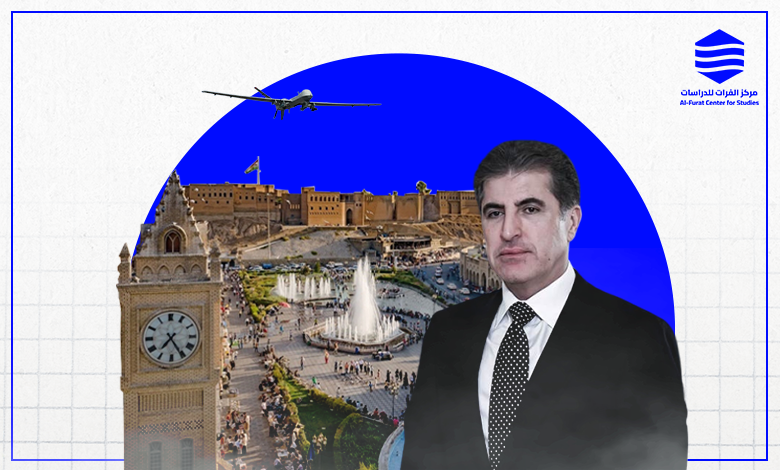
Targeting Nechirvan Barzani’s residence: between Iranian deterrence messages and the power struggle in Baghdad.
Lezgin Ibrahim – Researcher at Al-Furat Center for Studies
A few days after the Iranian strike that targeted Peshmerga positions in Soran—and Iran’s acknowledgment of the strike, claiming it was accidental—the repeated attacks on the Kurdistan Region shifted from targeting military headquarters, U.S. bases, and energy facilities to targeting the residences of the region’s leadership, such as the home of President Nechirvan Barzani and the surroundings of the residence of Kurdistan Democratic Party leader Masoud Barzani.
From here, the situation and its messages can be interpreted from two angles: the first relates to the trajectory of the war involving Iran, and the second concerns the political deadlock and the crisis of government formation in Baghdad.
The objectives and implications of focusing attacks on the Kurdistan Region.
Focusing attacks specifically on the Kurdistan Region is not incidental. The region possesses four characteristics that make it an attractive target for both armed factions and Tehran: it is the Iraqi area most closely connected to the United States and the international coalition; it hosts Gulf and Western diplomatic missions and interests; it represents a vital energy hub through fields and facilities such as Khor Mor; and it is the most sensitive geographic arena regarding Kurdish opposition groups to Tehran.
Accordingly, in March we witnessed the targeting of the UAE consulate in Erbil, a base hosting French forces, and Peshmerga headquarters, alongside continued threats that prompted Dana Gas to evacuate its personnel from Khor Mor.
Thus, targeting Kurdistan delivers a blow simultaneously to Washington, the Gulf, energy interests, and the Kurds.
U.S. Secretary of State Marco Rubio had previously thanked the Kurdistan Regional Government for enabling Iraqi oil—including Kurdistan’s oil—to reach global markets, a clear acknowledgment that the region carries weight extending beyond its internal boundaries into global energy dynamics.
Therefore, targeting it also conveys an economic message: whoever has the capacity to threaten Kurdistan has the capacity to threaten one of the last outlets of oil stability following the crisis of the closure of the Strait of Hormuz.
From this perspective, the implications of targeting the Peshmerga and the residence of the region’s president can be understood. For a long time, Tehran has viewed the Kurdistan Region not merely as a federal entity within Iraq, but also as a contact zone with Iranian Kurdish opposition groups, a potential platform for U.S. and Israeli activity, and a gateway for Gulf and Western policies it does not favor.
Following the Soran strike, the official Kurdish discourse was notably cautious. President Nechirvan Barzani stated, after the funeral of the fallen Peshmerga, that Tehran had acknowledged a “mistake,” offered condolences, and promised an investigation. At the same time, he emphasized that the region’s policy is clear: Kurdistan is “a factor of peace and stability,” not a source of threat to Iran or any neighboring country.
This language reflects Erbil’s commitment to a strategy of removing pretexts from the hands of Tehran and armed factions, and avoiding rhetoric that could justify an expansion of attacks. However, the subsequent attack on his residence after this statement suggests that a policy of de-escalation was not sufficient to deter those intent on sending a more explicit message.
The clearest political meaning here is that the targeting has shifted from the “military site” to the “political address.” When a Peshmerga base is struck, the perpetrating side can justify it through security narratives—such as claiming it was an operational error, an intelligence miscalculation, the targeting of Iranian opposition elements, or a response to a border threat.
However, when the targeting reaches the residence of the region’s president himself, the message becomes different: it places the political leadership under direct threat and pressure, signaling that the conflict will reach the core of Kurdish decision-making, not just its peripheries.
Shafaq News Agency described what happened as a moment of transition from “borders and headquarters” to “the doorstep of the region’s president’s home”—that is, from military pressure to direct symbolic pressure.
This latest attack, and the wave of widespread condemnation that followed, prompted the Iranian Revolutionary Guard to quickly distance itself from it, describing the targeting of Nechirvan Barzani’s residence as a “terrorist act,” while placing responsibility on the United States and Israel. Abu Alaa al-Wala’i, Secretary-General of Kata’ib Sayyid al-Shuhada, also declared that the attack was “condemned and rejected,” and contradicted what he referred to as the “ethos of the resistance.”
This language can be read as an attempt to contain the repercussions of a strike that went beyond targeting a base, facility, or energy infrastructure to reach a “Kurdish–Iraqi” political figure with broad political and symbolic standing. In this context, the operation shifts from being a message of security pressure to an assault on a political symbol, one that is difficult to justify before Iraqi and regional public opinion.
This interpretation gains further strength when considering the scale of solidarity that followed the attack. Iraqi Prime Minister Mohammed Shia’ al-Sudani condemned the operation and ordered the formation of a joint federal–Kurdistan security and technical team to investigate. Meanwhile, France, the European Union, Turkey, and the United Arab Emirates joined the wave of condemnation and support, alongside a U.S. position that once again linked the attack to the behavior of Iran and its proxies, just days after Washington had condemned the Iranian strike on the Peshmerga.
This broad consensus reveals that the targeting of the region’s leadership was understood, both internationally and regionally, as an attack on the center of balance and stability in Iraq represented by the Kurdistan Region.
This denial also opens the door to another hypothesis: the possibility of conveying a veiled Turkish message to the Kurdistan Region through local intermediaries, including Turkmen networks or Sunni/tribal formations in Nineveh. This is particularly plausible given that Asharq Al-Awsat reported on March 29, citing Turkish sources, that Ankara had hinted at military intervention in the Kurdistan Region if the Kurdistan Workers’ Party (PKK) and PJAK were to engage in a ground war inside Iran. According to the report, delegations from the Turkish Foreign Ministry and intelligence services delivered a clear message to regional officials: “We will intervene as we did in Syria.”
This hypothesis is not without basis. Turkey has a well-documented history of building influence within Turkmen and Sunni arenas in Iraq. A previous study by the Washington Institute indicates that Ankara supported the Iraqi Turkmen Front and used it politically, and went further by helping shape local Sunni forces following the establishment of the Bashiqa base. Reuters had also previously reported that forces trained by Turkey near Mosul included Turkmen fighters.
Accordingly, the coincidence between the attack on Nechirvan Barzani’s residence and Ankara’s escalation of threats against any Kurdish involvement in a war against Iran allows, at least theoretically, for interpreting the incident within a framework of indirect, deniable pressure.
On the other hand, it appears clear that Nechirvan Barzani’s role has come to exceed his formal capacity as president of a federal region, evolving instead into that of a leading Kurdish–Iraqi–regional representative. This point draws attention to his position, as his ability—alongside Masoud Barzani—to influence the selection of Iraq’s president and prime minister underscores the significant role the Kurdistan Region plays at the present stage.
At the level of the Erbil–Baghdad relationship, the situation presents two contrasting aspects. The first is relatively positive: al-Sudani condemned the attack, praised Nechirvan Barzani’s role in strengthening national unity, established a joint federal–regional security and technical team to investigate, and reaffirmed his rejection of dragging Iraq into a regional conflict.
The second aspect is deeper and more concerning: if attacks are repeated without real accountability, the message that will solidify in Erbil is that Baghdad is incapable of enforcing security and preventing “illegal actors” from striking the region. This widens the trust gap between the two sides and turns any negotiation over the presidency, the government, oil, and the budget into a negotiation under fire. At this point, the disagreement between Erbil and Baghdad is no longer merely about oil, the budget, or powers—it becomes a dispute over the very concept of the state itself: who protects the sovereignty of Iraq and the region, and who holds the decision over war and peace?
Implications of the Attack on the Path to Forming the New Government
The attack occurred at a moment when the Iran-aligned Coordination Framework forces were trying to revive the constitutional process for electing the president, as a precursor to appointing the prime minister. This gives the attack a political significance that goes beyond its immediate operational impact, because the election of the president in Iraq is the constitutional link that opens the door to appointing the prime minister within 15 days. This process had already been disrupted at least twice, in January and February, due to disagreements between the Kurdistan Democratic Party and the Patriotic Union of Kurdistan over the presidential candidate.
When the speaker of parliament now states that further delays are no longer acceptable, it indicates that any force seeking to obstruct the settlement or reset its terms will specifically target the Kurdish segment, as it has become the gateway from institutional paralysis to the formation of a government.
From this perspective, the targeting of Nechirvan Barzani’s residence and Masoud Barzani’s headquarters appears closer to a “disruption message.” Iran, the Coordination Framework, and Iran-aligned Iraqi factions sought to have Nouri al-Maliki become prime minister in the new government, but they were blocked by a U.S. veto and Kurdish obstruction of the parliamentary session to elect the prime minister. This delay, lasting until the outbreak of the Iranian conflict, undermined al-Maliki’s prospects and increased Mohammed Shia’ al-Sudani’s chances of securing a second term, as he represents a consensus choice with greater flexibility in managing regional and international relations.
Accordingly, the targeting of Nechirvan Barzani’s residence seems to be an attempt to shuffle the cards, raise the cost of any Kurdish alignment with al-Sudani in the presidential and government negotiations, and impose a security ceiling above the constitutional one. This suggests that militias within Iraq’s state structure, if unable to secure al-Maliki as prime minister, aim to retain influence over decisions of war and peace outside government control, and to keep the government formation process stalled, allowing them to operate within the margin created by the absence of a new government.
Consequently, the attack is likely to further complicate the situation rather than accelerate a solution. It may push the Kurdistan Democratic Party to harden its conditions, whether on the presidency or on issues of oil, the budget, and security guarantees, and it could make it more difficult to produce a presidential candidate with broad Kurdish backing, while delaying the renewal of confidence in al-Sudani.
In conclusion, the targeting of Nechirvan Barzani’s residence was, at its core, an attempt to recalibrate the boundaries of Kurdish maneuverability at a moment of regional war escalation and during the reshaping of power in Baghdad. It served as a warning that the Kurdistan Region, no matter how strong its Arab and Western ties, cannot negotiate over the presidency and government as if it were protected by a crude balance of power.
At the same time, the attack could produce the opposite effect. The higher the level of targeting—from consulates, oil fields, and military headquarters to the residence of the region’s president—the more convinced regional and Western capitals become that the matter is no longer merely an internal federal issue, but a direct test of Iraq’s sovereignty and its ability to prevent militias from imposing a “security veto” on politics.
If this trajectory continues, Nechirvan Barzani may emerge from the circle of threat politically stronger—not simply because he is president of the region, but because he has come to be seen by many as a figure of peace and compromise.