Trump’s Gaza plan: The starting point for re-engineering the regional order in the Middle East
Lezgin Ibrahim – Researcher at Al-Furat Center for Studies
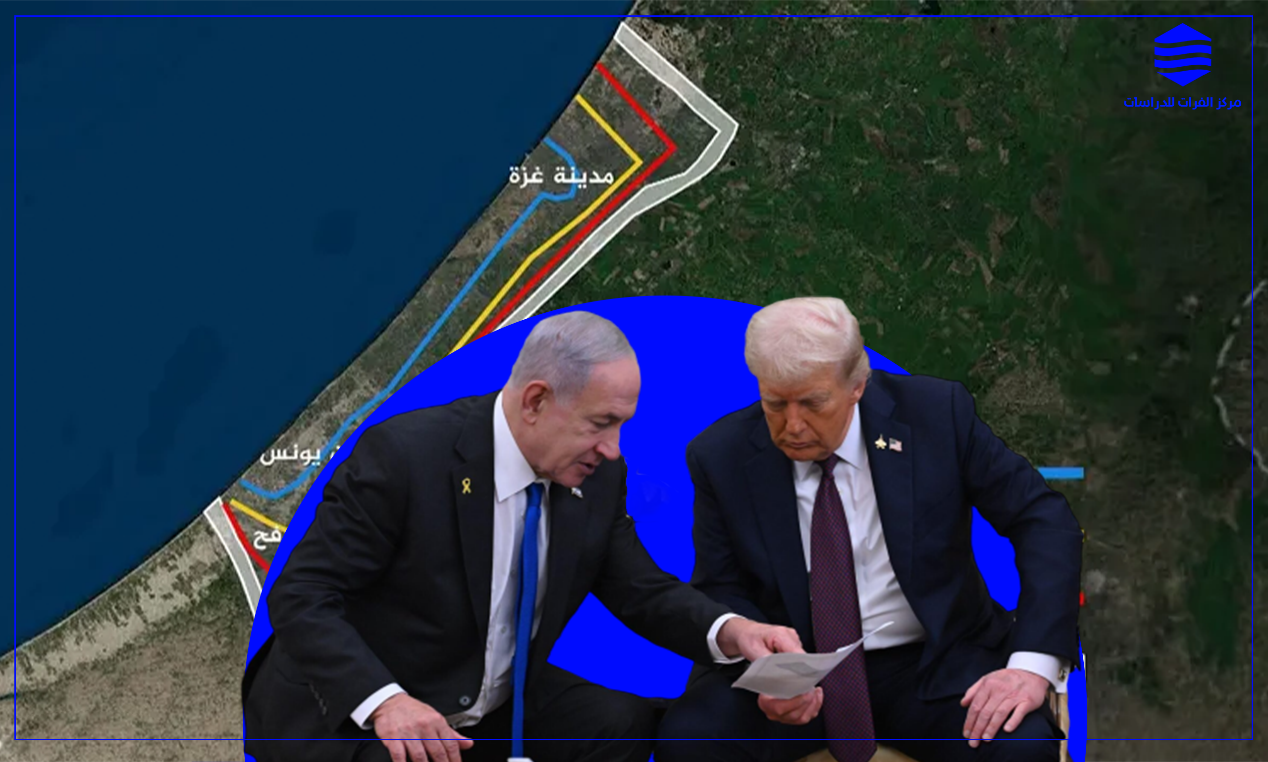
US President Donald Trump’s plan to end the war in Gaza represents a pivotal turning point in the course of the Arab-Israeli conflict and in the structure of the regional order of the Middle East, as this plan, which came after nearly two years of confrontation between Israel and Hamas, goes beyond the limits of a local settlement, to propose a re-engineering of the balance of power in accordance with the new American vision for the region, based on the concept of “peace through strength” and “dismantling the undisciplined structures” that Iran, Turkey, and the Muslim Brotherhood have used as tools of influence for decades.
With Hamas announcing its agreement to engage in negotiations on the plan, which includes a ceasefire and the release of hostages, and handing over the administration of Gaza to an independent Palestinian body raises a fundamental question about the course of the conflict and the possibility of its transfer to new arenas, most notably Iran, Lebanon and Iraq, and its repercussions on Turkish influence in Syria, in light of clear indications of a radical shift in the nature of regional power balances.
Trump’s plan as a tool to displace the Iranian and Turkish axes, and the rise of a new Arab centrality
The twenty points of the American plan announced by the White House carry profound political and strategic messages. It proposes the establishment of a technocratic transitional authority in Gaza under the supervision of an international committee headed by Trump, with the participation of figures such as Tony Blair, with the aim of transforming the Strip into an area free of terrorism and extremism, excluding Hamas and armed factions from any role in governance, in addition to launching a reconstruction and economic development plan under international supervision and an Arab-Western partnership, as a prelude to establishing a demilitarized Palestinian state within new security arrangements.
These provisions constitute an integrated project to eliminate non-state armed structures and transform Gaza into a model of peace imposed by force, where economic development becomes a tool to dry up the sources of violence and dismantle ideological organizations.
The success of the plan practically means the end of Iranian influence in Palestine, and the withdrawal of one of the most important arms of the “resistance” axis, which transforms the Palestinian issue from a card in the hands of Tehran and Ankara, into an Arab-American file subject to the management of Arab countries allied with Washington, such as Egypt, Saudi Arabia, the UAE and Jordan.
This shift entails a decline in the camp of political Islam, which used the Palestinian cause as a bargaining chip and propaganda tool, whether by Turkey or Iran, while the Arab states that have normalized relations with Israel emerge as a new central power managing security and political files, instead of the non-Arab powers that dominated the scene during the past two decades.
In this sense, the plan is redrawing the balance of power in the Middle East towards a greater role for Arab states, backed by Washington and Tel Aviv, in the face of two eroding regional projects: the Iranian project based on militias, and the Turkish project based on political Islam.
From a strategic perspective, Tony Blair’s return to the Middle East is a pivotal element in redrawing the equations of regional influence. His political and economic partnership with American and Israeli circles, and with some Gulf elites, reinforces a logic based on linking development and stability on the one hand, and political settlement on the other.
This reduces Ankara and Tehran’s ability to use and exploit the Palestinian issue. Recent moves indicate that the relationship Blair has forged with Gulf leaders, especially the UAE, enables him to play the role of mediator and unofficial architect of “economic peace” projects that link reconstruction with investment, thus turning Gulf money into an effective tool of political influence.
As a result, the Turkish role, which for a decade has relied on political rhetoric and Islamic symbols, will decline, while the economic and political power of the Gulf Arab states will emerge as a key factor in managing the Palestinian issue within an Arab-Western alliance system, thus consolidating a model of influence based on realistic projects rather than slogans.
Syria at the heart of the reshaping of the Middle East after Gaza
The Syrian file is one of the files most affected by US President Donald Trump’s plan to end the war in Gaza. Weakening Hamas means that Iran and Turkey will lose a common pressure card that they have long used in the equation of the Syrian-Israeli conflict, which opens the door to strategic shifts in Damascus and the region as a whole.
The new Syrian government is operating today within a climate that aligns with the American-Israeli vision for resetting regional security, as evidenced by its acceptance of the “demilitarized south” policy, its refusal to respond to Israeli incursions in Quneitra, and its undeclared concession of the Golan Heights.
This transformation is not separate from Trump’s plan, but rather represents a field extension of it. Just as a technocratic authority is imposed in Gaza under international supervision, a security environment will be built in Syria free of undisciplined armed organizations, whether affiliated with the Muslim Brotherhood or with Iran, in order to ensure that these forces’ ability to influence the course of events is restricted.
In this context, the United States appears to be pursuing a long-term strategic plan to play a pivotal role in the Middle East, aiming to achieve political and economic stability. Northeastern Syria stands out as a key pillar upon which Washington relies to maintain its position as a major player and observer of regional changes, The United States recently announced an extension of the state of emergency in Syria to counter threats, confirming the continuation of sanctions, while assessing ongoing security challenges, including the threat from ISIS and complex regional alliances. The decision came amid increasing pressure to reassess the relationship with the new Syrian government. The United States set conditions for easing sanctions related to transparency, political reform, protecting and involving all components of society in power, and Damascus’s commitment not to threaten American interests or its allies in the region.
All of this indicates that America seeks to maintain a kind of stability in Syria, in order to devote itself to the Gaza issue and eliminate Hamas, effectively and practically disarm Hezbollah in Lebanon, dismantle the pro-Iranian Popular Mobilization Forces militias in Iraq, and then determine the form of governance and administration in Syria, whether centralized, participatory, decentralized, or federal.
Until all of that is achieved, it is pursuing a tactical policy towards the new Syrian government led by anti-Iranian Islamists, to ensure that Iranian influence does not return to Syria, while it strategically needs the Syrian Democratic Forces as the most reliable force for the international coalition to ensure that ISIS does not return to Syria in the long term.
Accordingly, America will try to create a balance between Damascus and the SDF during the coming period, without allowing the two sides to slide into a direct confrontation or abandoning one side at the expense of the other. In this context comes the recent visit of the American envoy Thomas Barak and the commander of the American Central Command, Admiral Brad Cooper, to northeastern Syria, and the meeting with the leaders of the SDF and the Autonomous Administration.
They then sponsored a new round of high-level talks between the SDF and the interim government in Damascus, and reached an agreement to cease fire on all fronts.
Gulf money threatens Turkish influence in Syria
With the decline in international focus on the Gaza issue and the Gulf states assuming a prominent role in managing it, it will become clear that Gulf influence is imposing itself on decision-making processes in the region, from Gaza to Lebanon, Syria and then Iraq.
For Syria, which is undergoing a transitional phase following complex crises, reconstruction is no longer a technical task but an arena for political influence. The Gulf states have entered this arena forcefully through three parallel mechanisms: direct financing of reconstruction, debt rescheduling, or financial facilities, And a diplomatic mediation role to reintegrate Damascus into regional forums. These tools not only address Damascus’s need for resources, but also redefine the terms of regional participation and legitimacy in decision-making.
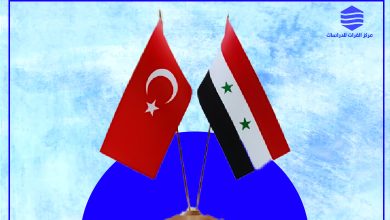
This economic and diplomatic shift undermines Turkey’s traditional instruments of influence and presents Ankara with a strategic challenge that must be addressed, otherwise it risks becoming a secondary player in a new regional equation. Through this shift, Turkey is losing a significant portion of its non-military tools of influence.
Turkey had trade networks, ports, and development projects that contributed to keeping it active inside Syria, and Gulf funding, which turned into an economic and political alternative, puts Ankara before two interrelated challenges: the first is internal, related to the weakness of its economic resources and its political and financial pressures, and the second is external, related to its ability to transform its military and security influence into long-term political influence.
As a result, Turkey’s role is gradually shrinking to managing security files on the borders and monitoring direct risks, instead of participating in setting reconstruction priorities and political planning.
Faced with this changing reality and Gulf competition, policymakers in Ankara may be forced to redefine their strategy, shifting from an approach based on direct military intervention to one based on political, economic, and pragmatic alliances to secure their vital interests, without a direct confrontation with Gulf, Israeli, or American powers.
Therefore, Turkey may try to make unannounced understandings with the Syrian Democratic Forces and the Autonomous Administration to ensure that northeastern Syria becomes an area of economic influence for Turkey. Therefore, Turkey’s continued incitement of Damascus against the SDF and obstruction of any understandings or agreements between the two parties can be understood. Fearing that any understanding and agreement between Damascus and the Autonomous Administration would open the doors to rapprochement and Gulf support for the SDF and the Autonomous Administration as well, Turkey finds itself facing the option of getting closer to the Kurds in Syria by maintaining the tension between Damascus and the SDF, while sending threatening messages to push the SDF and the Autonomous Administration to move towards understanding with Turkey and bypassing Damascus. It will try to strengthen its influence in northeastern Syria, and make it an arena for its investments and economy before it is hijacked by Gulf investors in the event that America pressures Damascus and the SDF to reach any form of understanding, achieve lasting stability and bypass the Turkish role. The beginnings of these Turkish efforts can be inferred from what Ilham Ahmed, the co-chair of the Department of Foreign Relations in the Autonomous Administration, revealed about ongoing negotiations to agree on the management of the Nusaybin crossing between northeastern Syria and Turkey. In conclusion, Ankara appears to be at a strategic crossroads that requires shifting its power tools from reliance on military capabilities to economic and flexible diplomatic approaches, in order to maintain its influence in Syria.
This scenario opens up three possible scenarios: First, Gulf-Western control over the political and economic development paths in Syria with relative Turkish marginalization; second, the creation of a multipolar regional balance where the powers (the Gulf, the United States, Russia, and Europe) share intertwined influence; and third, the continuation of the state of fragmentation and internal Syrian division, which may prolong the instability. Each of these scenarios will depend on the parties’ ability to translate funding and mediation into actionable political agreements, as well as on Ankara’s ability to adapt.
From Gaza to Beirut and Baghdad: A Reshuffling of Regional Influence
The end of Hamas represents a strategic turning point not only in Gaza, but also across Lebanon and Iraq, as US President Donald Trump’s plan presents the region with a comprehensive realignment of power. In Lebanon, the end of Hamas’s de facto presence puts Hezbollah in a profound predicament, as the party loses its primary justification for its existence as a “resistance” force defending the Palestinian cause.
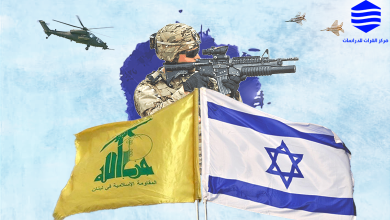
Especially since Trump’s plan allows Arab and regional powers to manage security in Gaza after the Israeli withdrawal, which weakens Hezbollah’s narrative about protecting southern Lebanon and its role as a Palestinian deterrent force. In this reality, the party faces two options: either transforming into a disarmed political movement participating in Lebanese political life, without interfering in regional issues, or engaging in a military confrontation with Israel that would end with a repeat of Hamas’s fate in Gaza.
Hezbollah appears to be apprehensive about these changes. The party’s Secretary-General, Naim Qassem, warned of the “dangers” of Trump’s plan, considering that the Israeli goal is to expand control over the countries of the region, in an attempt to raise concerns among the Arab countries supporting the plan, and the Arab and Islamic public. This reflects the party’s awareness of the existential threat it faces if the plan is fully implemented.
In this context, and with the end of the Hezbollah threat, the new pro-Western and pro-US government in Lebanon will be able to fully engage with its Arab surroundings, and may gradually enter into the Abraham Accords for normalization with Israel, whether directly or indirectly.
In Iraq, US pressure on pro-Iranian militias and the recent designation of some Popular Mobilization Forces factions as terrorist organizations coincide with the same objective: dismantling Iran’s regional influence network. With parliamentary elections approaching at the end of 2025, Iraq faces a critical choice. It is either the continuation of Iranian hegemony with its consequences of international isolation and the possibility of American and Israeli strikes targeting Shiite militias classified on terrorism lists, or engagement in a new Arab-Western axis that adheres to Trump’s expanded plan for regional peace. Thus, ending the war in Gaza becomes a starting point for reshaping the new Iraq as a state reconciled with the West, connected to its Arab axis economically and politically, and linked to an Arab-Western model of security and politics management in the region.
The vision
A strategic assessment following the end of the Gaza war, based on US President Donald Trump’s plan, indicates a qualitative shift in the structure of the Middle East’s regional order. The era of traditional ideological axes, represented by the resistance axis versus the normalization axis, is coming to an end, and a new Arab-American axis is emerging, leading the process of “rebuilding the Middle East” according to a vision that prioritizes stability and then peace through strength.
With the decline of the Iranian and Turkish role in favor of the Arab states that have normalized relations with Israel, political Islam is declining as an active force in the region, in favor of the “pragmatic Islam” model adopted by Saudi Arabia, the UAE and Jordan, which links economic development with political stability and regional security.
In Palestine, the concept of Palestinian sovereignty is being redefined within the framework of international governance and economic development, away from armed resistance, with the conflict being transformed from a military dimension to an economic-administrative dimension, managed by joint international Arab committees under direct American supervision.
Trump’s plan to end the war in Gaza is more than just a ceasefire; it is a project for a comprehensive restructuring of the regional order, aimed at closing the files on the Muslim Brotherhood, Hamas, Hezbollah, and Iranian militias, and replacing them with a new Arab-Western order based on new balances of power and economic and political alliances.
In this sense, Gaza is only the starting point, as Syria, Lebanon and Iraq will become the next arenas for implementing this vision, where the power of the Arab states that have normalized relations will emerge as a central factor in managing regional issues, while the Iranian, Turkish and traditional political Islam role will remain limited and marginal.
This shift reflects an integrated American-Arab strategic approach that seeks to impose a new system that balances political stability, economic development, and controlling regional conflicts according to clear rules that serve the Arab-Western axis in the Middle East.