How is America re-engineering the balance of power in Syria through a strategy of “annexation and integration”?
By Lezgin Ibrahim – Researcher at al-Furat Center for Studies
Available in Arabic
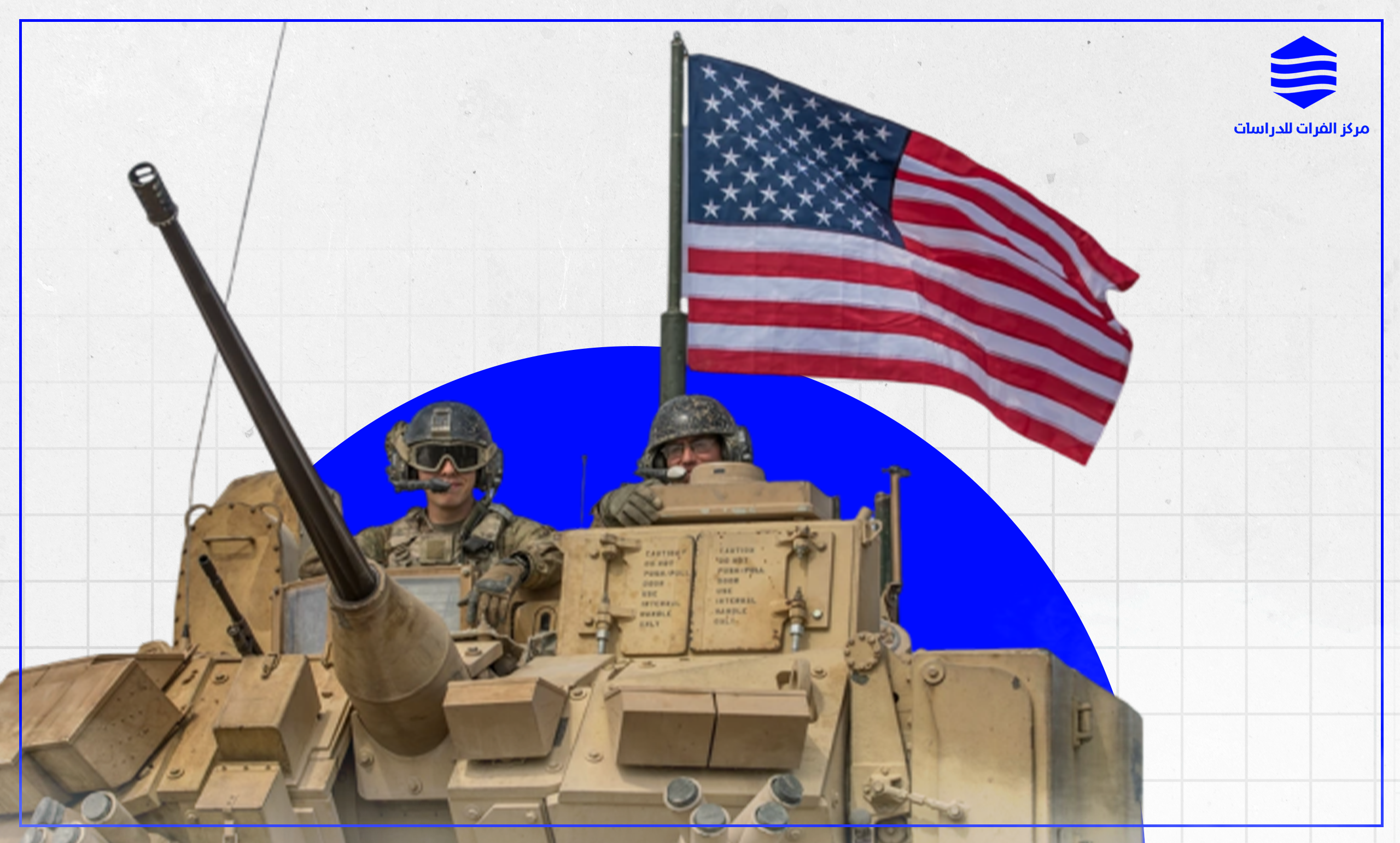
Post-Assad Syria, US policy is undergoing a new phase of strategic repositioning, reflecting a qualitative shift in its approach to managing influence. Washington has moved from a logic of direct military intervention to a methodology based on “quietly engineering balances,” working to reshape the Syrian landscape through local and regional alliances and partnerships, without completely withdrawing from the conflict. The new American strategy is to integrate Syria and its local forces into the international coalition to fight terrorism, and to create a network of regional and international alliances that allows it to control the balances internally and externally, while benefiting from local forces as partners in managing security and politics, in order to ensure the continuation of American influence in the long term.
The new American approach is “re-engineering balances and consolidating influence”.
The Syrian landscape entered a new phase of power restructuring in the fall of 2025, allowing Washington to manage the political and security transition in Syria, particularly in the north and east of the country. This involved intensifying military and logistical support for the Syrian Democratic Forces (SDF), the most reliable ally of the international coalition in the fight against ISIS cells with extensive training exercises in Qasrak, al-Shaddadi, and Kharab al-Jir, according to the Syrian Observatory for Human Rights, this confirms that Washington is working to shift the nature of its presence from direct field control to indirect management of the conflict through local partners, allowing it to maintain the upper hand in shaping Syria’s future without incurring the cost of direct involvement.
This approach intersects with the political shifts in Damascus, in terms of paving the way for the integration of the Syrian Democratic Forces into the structure of the new Syrian National Army, within the context of settling the balance of interests of local parties, while maintaining relative stability, reflecting Washington’s strategy of transforming its overt military presence into regulated institutional influence within the emerging security and political structures, ensuring the integration of its local partners into the nascent state without direct confrontation with the new authority headed by Ahmed al-Sharaa.
American analyses issued in 2025 by research centers such as RUSI and the Washington Institute indicate that the new American policy does not seek to dismantle Syria, but rather to gradually reintegrate it under close American supervision. Pressuring the SDF to engage in state institutions, while maintaining limited administrative and political independence, represents a translation of Washington’s vision of “containment through integration,” that is, transforming former adversaries into functional partners within the state system.
According to these American centers, even President Ahmed al-Sharaa’s visit to Moscow was part of a strategy to create a balance of power. Washington, which implicitly permitted the visit, does not see Moscow’s political engagement as a direct threat to its interests, but rather as a means to contain the Russian role within acceptable limits. The US administration has adopted what can be described as a policy of “flexible containment,” which allows Moscow to maintain the symbolic presence of its political existence without enabling it to rebuild its former military or economic influence. Herein lies the deeper dimension of the American approach: maintaining a state of monitored stability, preventing a strategic vacuum that Iran might exploit or through which Turkey might become active, while simultaneously ensuring that Syria remains in its position as a balanced theater of influence, not as an open front.
Objectives of including Syria in the international coalition
The recent American attempt to include the new Damascus government in the international coalition to fight ISIS appears to be a highly significant shift in the architecture of the American approach to the Syrian issue, as it cannot be read from a purely military angle, but rather as a complex political attempt aimed at legitimizing the long-term American presence in Syria. It is clear that Washington no longer deals with Syria as a land of conflict after cutting off Iran’s hand from it, but rather as a space for strategic repositioning through which it seeks to establish its presence as a regional guarantor of the balance between the active powers, especially between Turkey and Israel, taking advantage of the transformations that accompanied the rise of Ahmed al-Sharaa’s government as a new political front that is relatively acceptable to Washington and the international community.
Including Damascus in the international coalition also provides the United States with an entry point for building an intelligence and security partnership system, and gives it a doubled ability to monitor jihadist activities deep inside Syria without the need to increase the spread of American field bases, and to be satisfied with a central base that may be in the middle of the country or around Damascus especially since the majority of the organization’s cells are now concentrated in the desert and the vicinity of Homs and Aleppo, which are areas under the control of the new government.
But the deeper goal of including Syria in the coalition may go beyond combating terrorism to establishing the American presence inside Syria with a legal and official cover. Washington, which realized the predicament of legal legitimacy in its Iraqi experience, is seeking this time to consolidate its military presence through official agreements that allow it to build bases around Damascus under the slogan of “partnership in the war against terrorism.” It is a smart move to transform the American presence from a state of military exception to a state of permanent international alliance, thus giving it the ability to manage the Syrian scene from within, not from the periphery, and specifically from the decision-making center in Damascus.
In this context, the removal of Ahmed al-Sharaa’s name and a number of his government officials from the sanctions and terrorism lists can be seen as a preliminary step to consolidate this partnership. The American administration realizes that any intelligence or security partnership with Damascus requires removing it from the international isolation lists, and then preparing it to be an acceptable party in the new alliance. Thus, the Sharaa’s government becomes a political and security partner in the coalition system, which gives it indirect American protection from any internal threats or coup attempts, whether from jihadist factions or foreign jihadist forces that are still active in northern and western Syria.
The American objective in this matter is not limited to the Syrian interior, but extends to reshaping the regional map of influence. Through this accession, Washington seeks to engineer a new path for normalization between Damascus and Israel, paving the way for Syria’s eventual inclusion in the Abraham Accords. It appears that the statements made by US President Donald Trump, in which he indicated that sanctions on Syria would be lifted at the request of Israel and Turkey, were part of a political prelude to presenting Israel as a guarantor of stability in southern Syria, and Turkey as a potential mediator in any future dialogue between Damascus and Tel Aviv. In this way, Washington is trying to impose a dual power equation; Turkey in the north, Israel in the south, and America in the middle as the main guarantor of balance.
The role of the SDF after Syria joined the coalition
On the ground, it appears that Washington is seeking to leverage this alliance to establish direct communication channels between the Syrian Democratic Forces and the new Syrian government, within a unified framework for coordination under the banner of the international coalition. Reports indicate preparations are underway to form joint special units between the two sides, whose primary mission will be to pursue ISIS cells, And carrying out targeted operations deep inside Syria, under the supervision and training of coalition forces. This coordination does not in any way mean that Washington is relying entirely on the Syrian government to fight the organization; rather, all indications confirm that the SDF will remain the main spearhead in the counterterrorism strategy, being the most professional and organized force.
For more than a decade, the international coalition has built its relationship with the SDF on a foundation of trust and operational effectiveness, while the military and security apparatus of the Sharaa’s government still carries in its intellectual and field structure clear jihadist roots, which makes it unqualified to be an alternative to the SDF or a reliable partner in the war against ISIS. The jihadist structure that forms the core of the new army and security services will find it difficult to adapt to the reality of the alliance with Washington, and the coming period may witness sharp internal divisions between factions that see joining the alliance as a betrayal of Muslims, and others that consider it a necessity to protect the “state” from disintegration. Moreover, Sharaa, who does not have full control over all the factions under the umbrella of the Syrian Ministry of Defense, faces a real challenge in controlling the factions linked to Turkey or influenced by its religious and political discourse. It is not unlikely that the recent clash between government forces and foreign fighters in Idlib will lead to an escalation of internal opposition against him, especially if he proceeds to implement the coalition’s commitments in practice. Therefore, joining the “coalition” is not a redefinition of Damascus’s military position, but rather a political step to normalize Washington’s presence inside Syria and integrate Damascus into the international system without America becoming an occupying party.
The Sharaa government is still being tested
The suspension of the Caesar sanctions on Syria, following al-Sharaa’s visit to Washington, without lifting them permanently, serves as a political signal from Washington that the Syrian interim government is still being “tested,” and that it still has a long way to go before gaining full international legitimacy or solid American trust. The United States, having experienced the complexities of the Syrian arena for over a decade, understands that political legitimacy is not easily granted, and that lifting sanctions is not free unless promises are translated into clear, practical commitments. Therefore, the suspension of sanctions should not be interpreted as a reward, but rather as a form of soft pressure to compel the Shar’aa’s government to move in the direction required by America and Europe, including implementing the conditions related to combating terrorism, expelling foreign fighters, protecting religious and ethnic minorities, expanding the base of political participation, as well as achieving a lasting peace with Israel that ensures the neutralization of the southern front, and redrawing the regional security equation in accordance with American interests.
However, the implementation of these conditions is still faltering, not only because of the weak ability of the Syrian Interim Government to impose its full control, but also because of the nature of its ideological and military structure, which has not yet been freed from the jihadist legacy that formed its basis. While Washington expected the new Damascus to gradually move towards building more open and transparent institutions, it has become clear in recent months that the government is dragging its feet in implementing the agreed-upon commitments, and has even gone further by committing violations and massacres against the Alawite and Druze minorities in some areas, which deepened doubts about its ability to adopt a comprehensive national approach that transcends divisions and stops sectarian fighting.
The interim government is still stalling on committing to the terms of the “March 10 Agreement” signed with the Syrian Democratic Forces under American auspices, which represents a key pillar in the American vision to integrate local forces into state institutions and transform the SDF into an official partner in the Syrian national security system.
The agreement was supposed to be a turning point towards unifying the military and security institutions and strengthening the principle of internal partnership as a guarantee for the country’s stability and preventing the return of terrorist organizations. However, the delay in implementation by Damascus raised concerns in Washington and prompted it to reassess the extent of al-Shar’aa and his political team’s commitment to the promised reform path.
In this context, al-Sharaa’s visit to Washington came as an attempt to rebuild trust and demonstrate a willingness to correct course. Following the visit, the Syrian Foreign Ministry announced that an expanded meeting had been held between Syrian Foreign Minister Asaad al-Shaibani, his American counterpart Marco Rubio, and Turkish Foreign Minister Hakan Fidan, at the direct instruction of President Trump to follow up on previous understandings and establish clear mechanisms for implementing the March 10th agreement. The statement affirmed that the three parties agreed to proceed with integrating the Syrian Democratic Forces (SDF) into the Syrian army as part of a process to unify institutions and strengthen national security. This indicates that the United States considers maintaining its partnership with the SDF a cornerstone of its strategy in Syria.
At the same time, Damascus appears aware of the seriousness of this American assessment and is striving to portray itself as a partner committed to the international process. It periodically announces operations against ISIS cells, broadcasts news of foiled assassination plots against President Ahmed al-Sharaa, and intensifies its statements regarding the pursuit of foreign fighters in Idlib and the northwestern regions. But these steps still lack the deep practicality that Washington demands, as it sees them as more like media displays aimed at reassuring the outside world than as a comprehensive domestic strategy to combat terrorism.
In short, Washington appears to be reshaping the Syrian landscape with new, more subtle and effective tools. It is legitimizing its presence, linking Damascus and the SDF in a security coordination network under its supervision, and opening the door to understandings with Israel and Turkey that ensure everyone remains within its designated sphere of influence. In this way, Syria becomes an updated model of the “leading from behind” strategy: where America remains at the center of political and security control.