Protests in Iran and the tightening of the noose around the regime from within and without
By Aram Saeed – Researcher at al-Furat Center for Studies
Available in Arabic
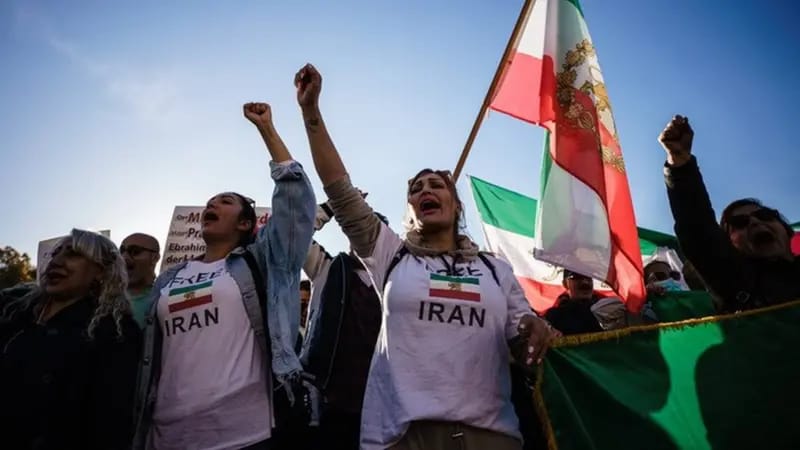
The protests that have erupted in the streets of Iranian cities since December 28 appear to represent a serious challenge that the Iranian regime is finding difficult to contain, given the state of comprehensive encirclement it faces from all directions. Most notably, this includes the Israeli–American strikes during the 12-day war and the possibility of their resumption at any moment, in addition to the recent U.S. operation in Venezuela and the arrest of its president, Nicolas Maduro.
Although protest movements -varying in form and cause- have become a familiar feature in Iran over recent years, this latest wave is distinguished by several fundamental characteristics that set it apart from previous movements. Foremost among these is the fact that its spark originated in the marketplace, or what is known in Iran as the “bazaar,” which has historically been a key ally of the Islamic regime and maintained a close cooperative relationship with the clergy against the Shah’s rule. This development constitutes a strong indication of the bazaar’s growing disengagement from religious authority, following the damage it has sustained as a result of regime policies that have driven the country into an inescapable impasse.
This protest movement also represents a new link in the chain of immense internal and external pressures imposed on the regime. More importantly, Iranian authorities -at the highest levels- have acknowledged the protests’ legitimacy, attempted to introduce certain reforms -albeit largely cosmetic and ineffective- and shown hesitation in resorting to excessive repression, for fear of further inflaming the unrest at this highly sensitive juncture. Added to this are statements by the U.S. president expressing support for the protests and warning the regime against suppressing them through violence. This, in itself, marks a significant shift in U.S. policy toward the Iranian regime, which had traditionally sought to contain and engage it rather than overthrow it. The stance of former President Obama remains vivid in memory, when he refrained from supporting the Green Movement protests in 2009 and instead sent a message of diplomatic accommodation to Khamenei, encouraging limited reforms to ensure the regime’s survival.
These developments are likely to contribute to an escalation in the intensity of the protests and an expansion of their scope, particularly as the regime hesitates to engage in large-scale killings of demonstrators. This dynamic may further synchronize with external pressures that could reach the level of Israeli military strikes backed by the United States, aimed at paralyzing the regime’s capabilities and dismantling its power structures in preparation for its eventual overthrow.
There is no doubt that the danger posed by the Iranian regime remains intact. Indeed, cornering it to this extent may increase its threat to its own people, its regional environment, and its adversaries, especially given reports that it has rebuilt its missile arsenal, alongside leaks suggesting that Khamenei has ordered the development of tactical nuclear warheads. This factor has thus far restrained Israel and the United States from launching a second wave of attacks, prompting them instead to adopt a wait-and-see approach while closely monitoring developments inside Iran. Such restraint, however, does not imply a cessation of efforts to unravel the complex web underpinning the regime’s power. The recent “near-magical” operation carried out by U.S. Delta Forces against Venezuelan President Nicolas Maduro constituted a decisive blow that is expected to cripple the Iranian regime’s economic capabilities and sever its extensive influence in Latin America via the Venezuelan gateway.
This incident rang loudly in the ears of Supreme Leader Ali Khamenei, as part of a cascading series of dominoes falling toward Iran, beginning with the targeting of Iran’s proxies and the assassination of senior figures such as Qassem Suleimani, Mohsen Fakhrizadeh, Hassan Nasrallah, Hussein Salami, and Amir Hajizadeh, and culminating in the collapse of the Assad regime and Iran’s complete loss of its foothold in Syria. For the Islamic Republic, Maduro had represented the leader of the so-called “Axis of Resistance” outside the Middle East, on the American front. Latin America had served as a hub for the economic activities of the Islamic Revolutionary Guard Corps and Hezbollah, as well as a shadow theater for networks of organized crime, smuggling, and money laundering linked to both.
With the erosion of the Strait of Hormuz as a viable leverage card and the diminishing feasibility of shifting the confrontation to the Gulf, particularly after U.S. control over Venezuelan oil and gas, there now appears to be little standing in the way of a large-scale military action targeting centers of power inside Iran. Such an option may prove increasingly tempting for Israel, despite all potential risks, should it perceive the situation inside Iran as slipping out of control, an outcome that could unfold dramatically in the coming phase.